Posted: Tuesday, 17 February 2026
They are caused by the components that surround it.
For engineers designing systems, and procurement teams sourcing replacements, it is worth remembering one simple truth:
UV dose is a system outcome. Not a component feature.
Set out below is what that means in practical terms.
1. Quartz Sleeves: Transmission, Protection and Stability
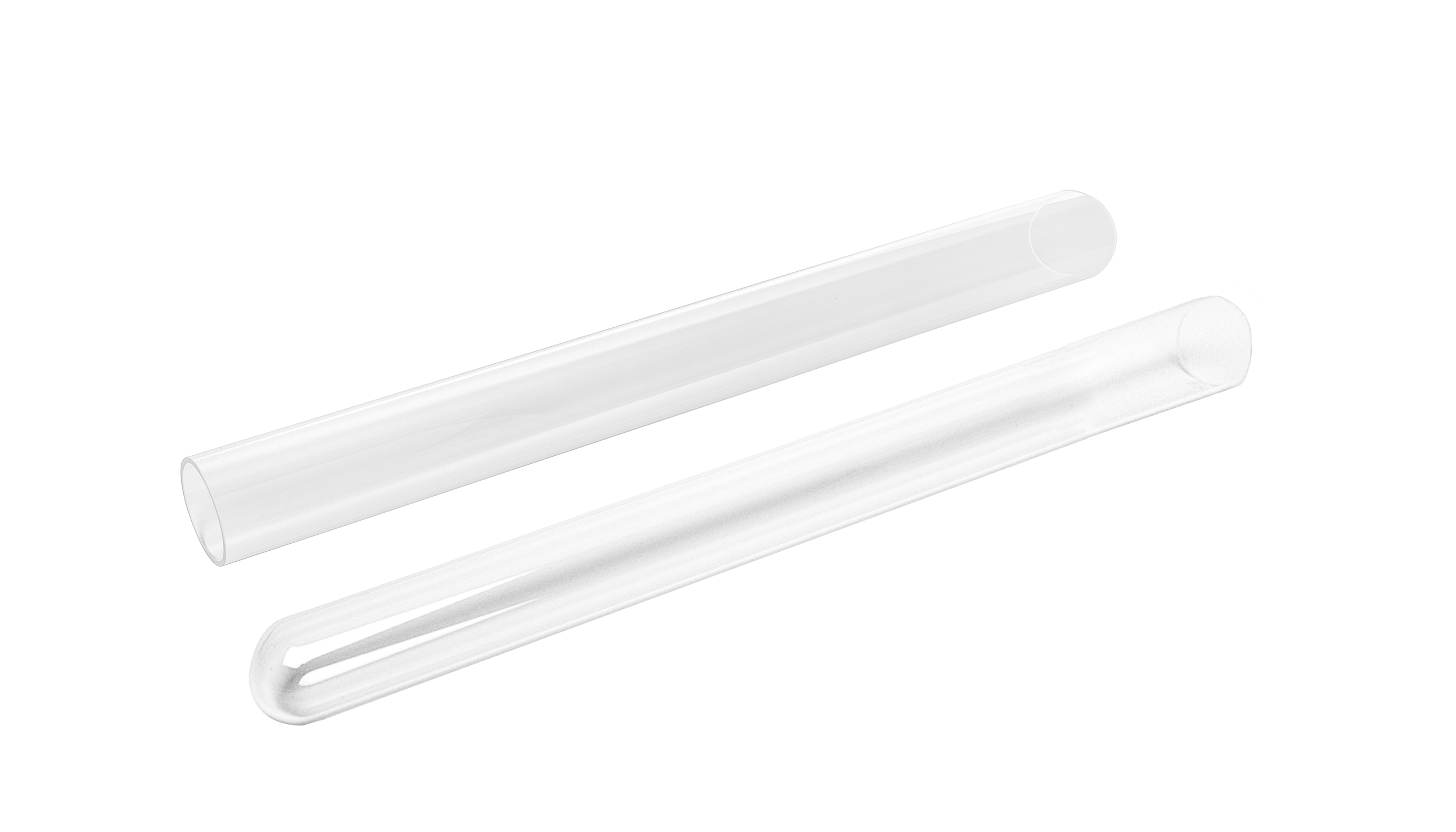
The quartz sleeve does more than keep water off the lamp.
It directly affects UV transmission efficiency, fouling rates, thermal stability and long term output consistency.
Poor quality quartz or incorrect specification can result in:
-
Reduced UV transmission
-
Accelerated fouling
-
Microfractures under thermal stress
-
Difficult maintenance procedures
For OEM engineers, sleeve dimensional accuracy matters with tolerances affect sealing, alignment and thermal expansion.
For procurement teams, consistency across batches matters with variations in wall thickness or material grade can alter performance.
At Alpha-Purify, we sell open and closed ended quartz sleeves in multiple diameters and lengths, including ozone resistant and ozone free options. The goal is not just compatibility, but stable transmission and predictable lifecycle performance.
Because dose calculation assumes transmission values are correct.
2. O-Rings: Small Components, High Consequence
 An O-ring is easy to overlook.
Until a seal fails.
An O-ring is easy to overlook.
Until a seal fails.
Leakage in a UV reactor can mean:
-
Electrical risk
-
Contamination
-
System shutdown
-
Compliance breaches
Material compatibility is critical. EPDM, FKM and other rubber compounds behave differently under temperature, chemical exposure and pressure.
For engineers this means specifying the correct compound and hardness ensures reliability.
For procurement this means ensuring repeat supply of identical material grade prevents silent system degradation.
We supply replacement O-rings in a wide range of diameters and thicknesses, and where required, can quote to match existing system designs.
Because sealing integrity is not an accessory issue. It is a safety issue.
3. Ballasts and Power Supplies: Output Stability Equals Dose Stability
A UV discharge lamp does not regulate itself.
Ignition characteristics, arc stability and output consistency are determined by the power supply design.
Incorrect or unstable power delivery leads to:
-
Fluctuating UV intensity
-
Reduced lamp life
-
Hard starts and electrode stress
-
Higher energy consumption
For engineers, matching ballast characteristics to lamp type and operating environment is essential.
For procurement teams, purchasing based on price alone can introduce hidden operational cost through early failures and inefficiency.
Alpha-Purify provides chokes, ignitors, transformers, capacitors and complete power supply units designed to match specific lamp types and applications.
Reliable ignition and stable operation protect both dose delivery and lamp investment.
4. UV Sensors: If You Cannot Measure It, You Cannot Validate It
Regulated industries do not operate on assumption.
They operate on measured performance.
UV sensors allow operators to:
-
Monitor real time intensity
-
Identify fouling trends
-
Detect lamp ageing
-
Trigger maintenance before failure
Temperature sensors add another layer of protection, ensuring system output conditions remain within safe parameters.
For engineers this translates as integrating sensor ports and monitoring logic from the design stage avoids expensive retrofits later.
For procurement professionals, investing in monitoring capability reduces risk exposure and audit pressure.
Performance validation is not optional in drinking water, aquaculture, food and beverage, healthcare or wastewater applications.
It's expected.
5. Control Panels: Turning Components into a Managed System
Hour meters. Timers. Remote on and off. Alarm outputs.
Individually, these are simple features.
Collectively, they define how manageable your UV system is.
Without proper control integration, maintenance becomes reactive instead of planned.
For engineers, designing with integrated monitoring and alarm logic improves system credibility.
For procurement, specifying panels with proper visibility reduces operator error and extends asset life.
Control is what transforms a UV assembly into a dependable disinfection system.
Learn more here
6. UVC Dosimeter Test Dots: Visual Proof of Exposure
Modelling and calculations are important.
Verification is better.
Our UVC Dosimeter Test Dots provide visible confirmation of UV-C exposure at 254 nm across four thresholds: 25, 50, 75 and 100 mJ/cm².
For engineers, they can help:
- Identify shadowed zones
-
Optimise reactor configuration
-
Validate exposure times
For procurement and compliance teams, they support:
-
Commissioning documentation
-
Audits
Internal performance verification
They are a simple, cost effective validation tool with a three year shelf life.
Sometimes a visual confirmation carries more weight than a spreadsheet.
Why All This Matters for Engineers and Procurement
Of course a high quality UV lamp is essential (we would say that wouldn't we!).
But dose delivery also depends on the above described elements of the overall system:
-
Optical transmission
-
Electrical stability
-
Sealing integrity
-
Monitoring capability
-
Operational control
-
Validation methods
Remove strength in any one of those areas and system performance can easily decline.
At Alpha-Purify, we manufacture and supply medium-pressure and low-pressure lamps, but we also supply the surrounding components that ensure those lamps deliver consistent, measurable, compliant performance.
For OEMs, that means design compatibility and technical support.
For end users and procurement teams, that means supply continuity, matched components and reduced operational risk.
If you want to explore how to safeguard your disinfection system performance, contact the Alpha-Purify team for a more in-depth conversation. Contact Us